The AI Boom Has a Construction Problem.
By Francesco "Frio" Iorio, Founder & CEO, Augmenta
Everyone is talking about how much infrastructure AI will require. The numbers are staggering. By 2030, technology companies are projected to spend roughly $7 trillion on data centers worldwide. Of that, approximately $1.4 trillion goes directly into the mechanical, electrical, and plumbing systems that make those buildings function.
I want to talk about what that number actually means for the people who have to build them.
The electrical system is the hardest part of the hardest building type in construction.
Data centers are not like other commercial buildings. MEP systems make up 40 to 55 percent of total construction costs in a data center, compared to 15 to 25 percent in a standard commercial build. Within that, the electrical system is the lifeblood of the entire facility. Every conduit run, every raceway routing decision, every foot of wire shaved from the design has a direct impact on power consumption, construction cost, and how fast the building can go live.
And unlike most commercial buildings, where electrical comes in near the end of the design sequence, data centers flip that model entirely. Electrical has to lead. The GPU racks are engineered with sophisticated physics simulations. The cooling systems are modeled with precision. The electrical design, by contrast, is still largely done by hand.
I do not say that to disparage the engineers and VDC teams doing this work. They are some of the most talented people in the industry. But the tools they have been given have not kept pace with the complexity of what they are being asked to deliver.
The pressure on electrical contractors has never been higher.
Hyperscalers cannot afford to always be patient clients. Delays on a data center project can cost developers up to $14.2 million per month in lost revenue, overruns, and penalties. The schedule pressure is relentless, and yet the design handoff to electrical contractors is still one of the most compressed windows in construction. Electrical gets the least detailed documentation at the start, works under the tightest coordination constraints, and is expected to produce a fully coordinated model before the first BIM meeting.
On top of that, 41 percent of the construction workforce is projected to retire by 2031. The experienced VDC talent who can route miles of electrical raceway through a million-square-foot facility, and anticipate every coordination conflict before it becomes a clash - that population is shrinking. The demand for their expertise is trending in exactly the opposite direction.
LLMs are not the answer to a geometry problem.
The construction industry has been flooded with AI tools over the past two years, and most of them are built on Large Language Models. Some of these tools are genuinely useful. For parsing specifications, generating project-specific scripts, or automating contract review, LLMs are well suited.
But LLMs cannot reason through three-dimensional physical space. They cannot understand that a conduit run here forces a conflict there, or that shaving six inches off a raceway path across an entire floor changes the power load calculation in a meaningful way. That requires a fundamentally different kind of AI. It requires a spatial computation engine built from scratch and based on the stringent geometry of real buildings, paired with machine learning that has absorbed decades of how experienced detailers actually make decisions.
That is what we set out to build at Augmenta.
What this looks like in practice.
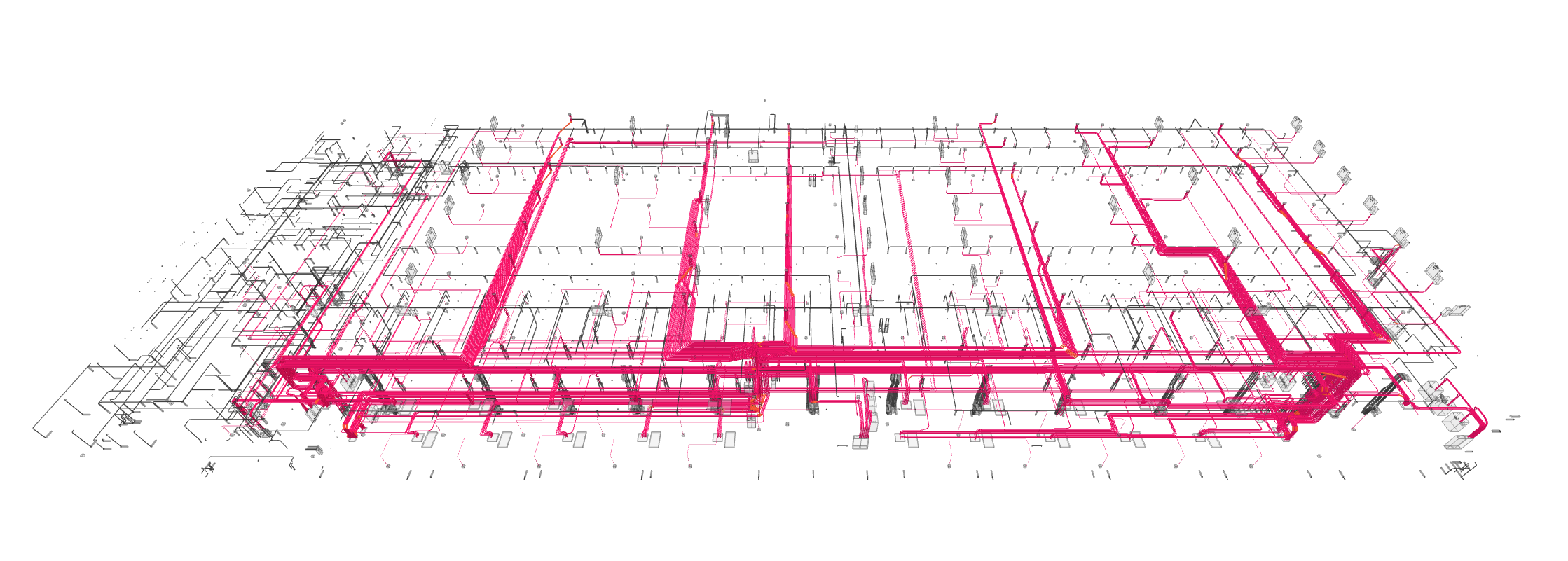
On a 330,000 square foot data center, our platform reduced manual electrical modeling time from 320 hours to 96. That is roughly ~28 working days recovered, on the initial model alone. On another project, a customer used Augmenta to route over 18 miles of electrical conduit in 72 hours; a task that would have taken weeks by hand.
We have worked with the large electrical contractors building data centers for every major U.S hyperscaler. Optimized electrical routing has delivered single-digit energy efficiency gains, alongside measurable reductions in material waste. On a facility that runs 24 hours a day, 365 days a year for decades, these have consequential implications.
The engineer still makes the call.
I want to be direct about something, because I hear the skepticism and I think it is healthy. Sixty-five percent of construction professionals report neutral or low trust in AI outputs. That is a rational response to a lot of overpromised technology.
Our technology does not remove engineers from the process. It removes the repetitive, time-consuming work of manually routing and re-routing geometry so that engineers can focus on the decisions that actually require judgment. Constructability review, coordination trade-offs, field conditions, value engineering trade-offs where someone with experience needs to weigh in. None of that goes away, but rather the time gets reallocated. What goes away is spending 320 hours on a model that should take considerably less time - the demand and pressure requires quicker modeling.
The goal is to give your VDC team the time and mental bandwidth to complete the work only they can do.
Why this matters beyond the data center.
When we started Augmenta, I was thinking about more than construction efficiency. I was thinking about what it would mean to make high-performance building design the default outcome on every project, not just the ones with the biggest budgets. The high perceived cost of changing to a more efficient process has historically been a barrier to doing things right. Core building system design automation does not just make things faster; it enables more time for critical decision-making, and those benefits are also accessible at scale.
Data centers are where that capability is being stress-tested right now, because the stakes are highest and the timelines are shortest. But the same platform, the same spatial AI that routes dozens of miles of electrical systems through a hyperscale facility, is also at work on hospitals, schools, and infrastructure projects where getting the design right has consequences that outlast the construction contract.
Everyone is talking about how much infrastructure AI will require. What’s becoming apparent is that building that infrastructure needs AI.
