Conversations at the Intersection of AI and the Built Environment
Augmenta is building the foundational Spatial and Functional AI for construction, technology that understands the geometric, structural, and functional constraints of the built environment well enough to generate fully engineered, construction-ready building designs, starting with electrical design and expanding into mechanical and plumbing, and beyond.
Realizing this vision requires progress on some of the hardest open problems in AI: 3D generative modeling, structured representation learning, spatial reasoning, and constraint-aware design, all in the highly complex domain of 3D building models, where scale, multi-trade interdependencies, and zero tolerance for error make this a fundamentally different problem than generative AI for visual or digital content.
Through the Augmenta Invited AI Speaker Series, we connect with leading researchers and practitioners to share their work at the frontier of these topics, fostering the kind of cross-disciplinary dialogue that will push AI beyond the digital and visual domains and into the physical world.

Our first invited speaker was Iro Armeni, who is an assistant professor of Civil and Environmental Engineering at Stanford University. Iro’s research is at the intersection of civil engineering, architecture, and machine perception to design and construct data-driven sustainable and adaptive environments across the physical and digital space. She has worked as an architect and consultant for both the private and public sector.
Her talk was titled “Designing with What We Have: Generative Reuse in Interiors.” The presentation introduces her latest work on AI-driven tools that reimagine how we approach interior renovation, layout design, and object reuse, with the ultimate goal of building design from reuse. ReStyle3D enables rapid visualization of new interior styles grounded in the geometry and semantics of existing spaces. I-Design and ReSpace3D support sustainable layout planning by facilitating reuse of furniture and layouts in context-aware ways. Finally, Rectified Point Flow addresses object circularity by enabling the reassembly of furniture from disparate parts, promoting a new vision for sustainable product lifecycle integration.
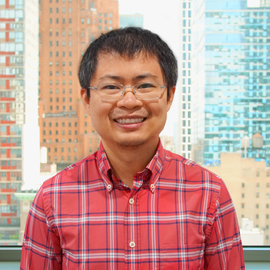
Our next speaker will be Chen Feng, who is an Institute Associate Professor at New York University, Director of the AI4CE Lab, and Founding Co-Director of the NYU Center for Robotics and Embodied Intelligence. He has also been an Amazon Scholar with its Frontier AI & Robotics team since 2026. Chen’s research focuses on active and collaborative robot perception and robot learning to address multidisciplinary, use-inspired challenges in construction, manufacturing, and transportation. He is dedicated to developing novel algorithms and systems that enable intelligent agents to understand and interact with dynamic, unstructured environments.
Before NYU, he worked as a research scientist in the Computer Vision Group at Mitsubishi Electric Research Laboratories (MERL) in Cambridge, Massachusetts, where he developed patented algorithms for localization, mapping, and 3D deep learning in autonomous vehicles and robotics. Chen Feng earned his doctoral and master's degrees from the University of Michigan between 2010 and 2015, and his bachelor's degree in 2010 from Wuhan University. Chen is an active contributor to the AI and robotics communities, such as CVPR, IEEE RA-L, and ICRA, and he has served as an area chair and associate editor. In 2023, he was awarded the NSF CAREER Award. More information about his research can be found at ai4ce.github.io.
We will schedule Chen’s talk in early September 2026. Please stay tuned.
