Outnumbered, Undertrained, Undeterred
Earlier this year, a nine-person team of students from Illinois State University entered a NECA-sponsored student competition that asks students to step into the role of an electrical contractor and take a project through a full project life cycle. The competition covers estimating, scheduling, BIM coordination, sustainability, and project execution, with submissions judged by industry professionals.
Many of the other teams came from larger schools with established engineering programs, including schools like Purdue, Penn State and more. Some of the other teams had 20 or 30 students working on the project. ISU had nine, and unlike many of their competitors, ISU’s engineering program does not officially launch until next semester. This team was made up mostly of non-technical construction management students.
They were the underdogs; going up against teams of electrical engineers and experienced Revit users.
.png)
The project: A real-world electrical workflow, start to finish
Each team was given a three-story hospital project and asked to deliver a complete electrical package just like a contractor - they needed to plan, coordinate, and execute the work. For ISU, that meant producing a 3D model, estimates, construction schedule, alongside all supporting materials, and submitting the full project for review by industry professionals.
The project covered four major areas:
- Bidding and estimating
- Project management execution
- BIM coordination
- Design-build innovation
For the Illinois State University team (Zach L., Jesus C., Rosario P., Jason T., Jason C., Adrian P., Klarissa C., Yasmine D., Vinny K., and Drilon B.), much of Zach and Jesus’s work centered on Revit. They helped build the model, place the electrical equipment, create the feeder schedule, and determine how to route conduit. Neither came into the project with deep electrical modeling experience.
Jesus, a construction management student, said he had never done electrical model work before the competition. He started by digging into the plans, learning how to read the one-line diagrams, and understanding the wiring, panels, and equipment so they could build the model correctly.
Zach had used Revit only once or twice before.
“I had only used Revit really once or twice before,” he said. “So it was a very, very steep learning curve.”
Learning Revit and BIM coordination at the same time
At project kickoff, the team received one-lines showing the equipment and the connections between panels, switchboards, transformers, and other gear. From there, they had to place the equipment into the Revit model, build the feeder schedule, and determine conduit routing.
That alone would be a lot for an experienced BIM team. For two students learning Revit and modeling as they went, it was overwhelming.
They placed roughly 90 panels in the model, along with switchboards and transformers. Then came the part that they were most nervous about, and that could have consumed the rest of the semester: routing more than 150 conduit runs through a complex hospital.
The team knew manual routing would be difficult. They were new to Revit, short on time, and working with a much smaller team than many of the other schools.
So, based on a recommendation from a project sponsor, they turned to Augmenta.
From Feeder Schedule to Routing Options
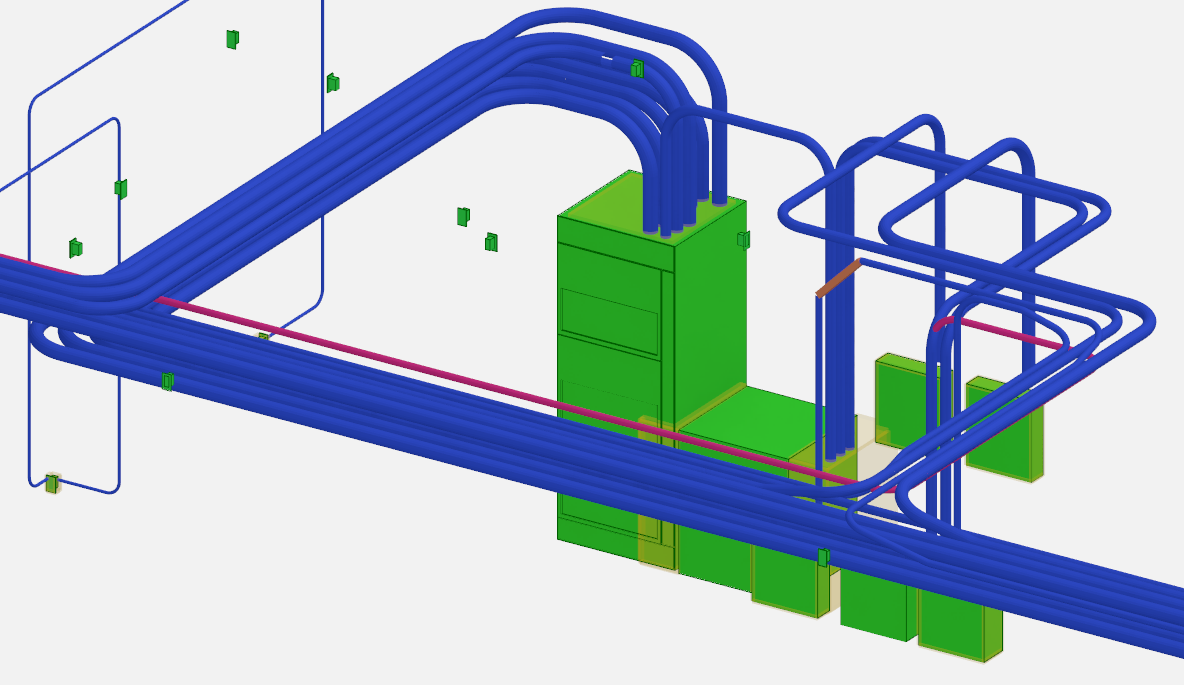
Once Zach and Jesus had the feeder schedule built and the equipment placed in Revit, they imported the schedule into Augmenta and used it to generate conduit routing options they could review, refine, and bring back into the model.
They guided the output with keep-out zones and preferred routing paths, and used Augmenta to run initial solutions. They compared options to reduce conduit, lower projected costs, and refined routing pathways.
“You would see the run initially,” Jesus said. “So then you could identify ways to improve the patterning, so we could use less conduit. It would make the cost a lot cheaper. And it would make the whole building process more efficient.”
Augmenta’s AI-powered routing and coordination did not remove the students from the process; it gave them a practical entry point into work that would have been extremely difficult to complete manually in the time available. They now had more time to understand the project, review routing, and problem-solve, but they were no longer starting from a blank screen.
When asked how long it would have taken without Augmenta, they were direct.
“Without Augmenta, I’d say probably five times longer,” one of them said. “There’s no way we could have routed that much conduit manually and still met the competition deadline.”
They estimated it would have taken at least three months with both of them working on it in Revit, that was time they did not have. The competition started in January and wrapped in early May, all while the students were carrying full course loads, working internships, and meeting several times a week to keep the project moving.
The model became the strongest section
The year before, ISU had finished near the bottom of the competition. According to the students, the model had been one of the weaker parts of the submission. This year was different.
“We did pretty good on the Revit model,” Zach said. “And that was the downfall of last year.”
Jesus agreed that this year represented a big step up.
“We really wanted to improve on that,” he said.
The model had been a weak point the year before. This time, the students were able to turn one of the most challenging parts of the competition into one of the areas they felt most confident about.
.png)
What they learned about AI in construction
One of the most interesting parts was hearing how quickly the students understood how AI could fit into the process. They did not describe it as a replacement for people, but as a tool that augmented their work.
Zach put it simply:
“To me, it’s an assistant.”
A skilled person still needs to understand the project. Someone still needs to check the routing, compare options, set constraints, review clearances, and think through how the model will support coordination, prefab, submittals, and the work that eventually reaches the field.
But when a tool can compress a routing task from months of work into something a small student team can realistically complete, it changes what is possible. Technology becomes less like a shortcut and more like a digital apprentice: a helpful hand that gives modelers a way into the work while leaving the critical decisions to humans.
It also changes what can be learned. For Jesus, the tool did not reduce the need to understand the job; it motivated him to examine the project more closely and deepened his curiosity about how it all worked.
“It helped me understand the project more,” he said. “So I knew that I was doing it right.”
A Big Step Forward for the Redbirds
ISU did not finish in the top three this year, but how this group of nine construction management students competed against larger schools with bigger teams and more established engineering programs says a lot about them, and what's possible.
Zach, Jesus, and the rest of the ISU team took on a full electrical project and pushed through work that was new, technical, and at times overwhelming. They learned enough electrical, Revit, and BIM coordination to place equipment, build schedules, route conduit, review solutions, and submit a model they could stand behind.
With curiosity, a lot of late nights, and access to helpful tools, students who were still learning the workflow got a real look at what electrical contractors are asked to do: turn design information into something coordinated, constructible, and ready to build.
No trophy changes that.
Congratulations to the Redbirds - we’re excited to see to see how the team does next year!
